
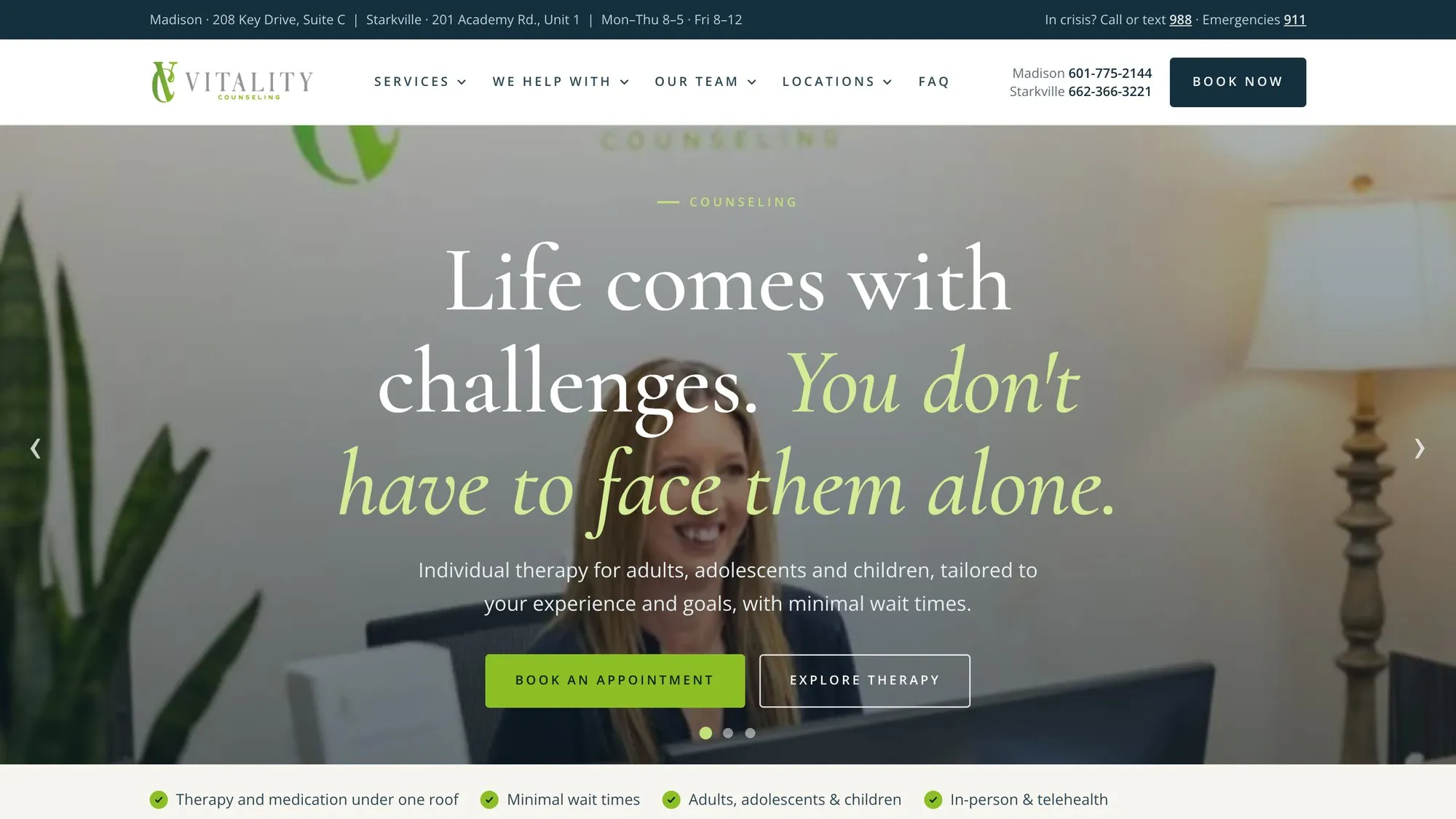
Vitality Counseling had grown into a two-office practice with 13 clinicians, but its website still read like a business card. Gridwell rebuilt it around the questions people actually ask when they are looking for help: what they are struggling with, who treats it, whether their insurance is accepted, and how to book.
The Client
Therapy and Medication Management Under One Roof
Vitality Counseling is a behavioral health practice in Mississippi, founded by Craig Watson, LPC-S. Nine therapists and four psychiatric prescribers see adults, adolescents and children at offices in Madison and Starkville, and by telehealth across the state. The Starkville office opened on 05/18/2026.
Having therapy and psychiatric medication management in one practice sets Vitality apart. Many patients need both, and most have to find them in two different places.
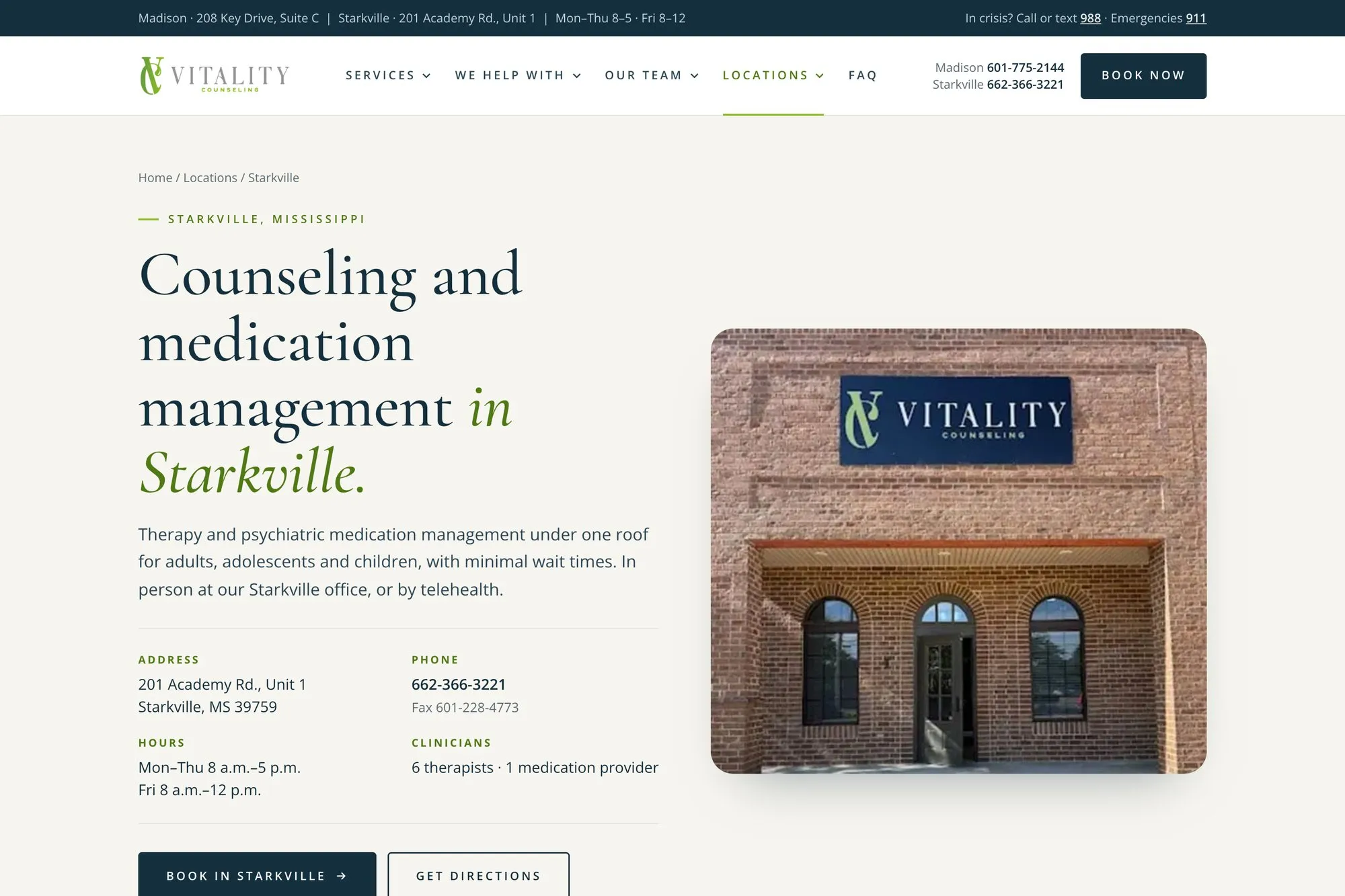
Gridwell has supported Vitality since before the Starkville launch, through CRM management, print collateral and the website. We designed the rack cards for the Starkville opening. We set up booking-form leads to be tagged and routed by location. We also connected each Google Business Profile to its own location page.
The Challenge
A Site That Described the Practice but Couldn’t Be Found
We audited the old WordPress site before rebuilding it. The basics were in order: it was reasonably fast on simple pages, listed every phone number and had a working sitemap. The problems were depth and structure.
- No pages for what patients search. All services sat on one page. There was nothing on anxiety, ADHD, trauma, child therapy or medication management, and nothing that named an insurance plan. The median page carried 60 words of real content.
- Patients couldn’t tell who to see. Each clinician had a separate page of bullet points with no written bio. Booking was split across four overlapping pages.
- Structural gaps. 11 of 29 pages had no H1, and 89 images had no alt text. Three test pages were public and indexable. Markup describing the practice and its offices appeared on only two pages.
- The team page was slow. It took 12.3 seconds to show its main content on mobile and pulled 10.4 MB on desktop, mostly full-size headshots.
- No privacy framework. For a behavioral health practice, the site had no privacy policy, terms, cookie notice or Notice of Privacy Practices.
The result showed up in search. Outside the practice name and a few Madison searches, Vitality was largely invisible. It reached Google’s first page for 3 of 8 non-brand searches and was named by Perplexity for 2 of 7 questions. Starkville ranked 12th or 13th in the map results for every term we tested.
The Strategy
Build the Pages People Are Searching For
People looking for counseling rarely search a practice’s name. They search for what they are dealing with, where they live and whether their insurance is accepted. So we built the site around those three questions.
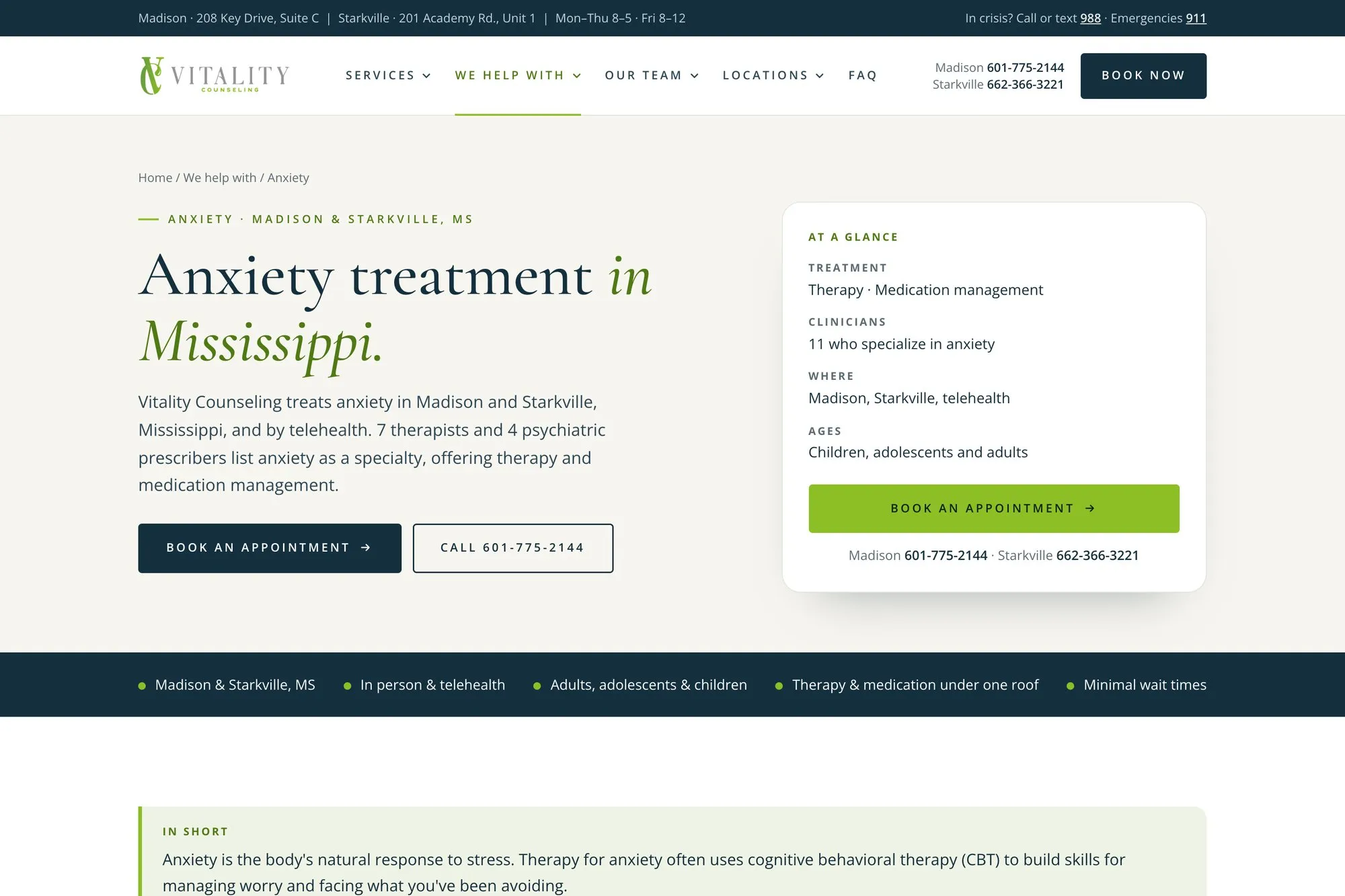
Conditions and services. We wrote 13 condition pages: ADHD, anxiety, bipolar disorder, child behavioral therapy, depression, eating disorders, grief, LGBTQ+ affirming therapy, life transitions, OCD, relationship and family counseling, substance use, and trauma and PTSD. We added pages for therapy, medication management and telehealth, with a services hub over them. Each condition page opens with a short answer, explains how Vitality treats it, and shows the clinicians who list it as a specialty. Each closes with an FAQ written for the questions people actually ask.
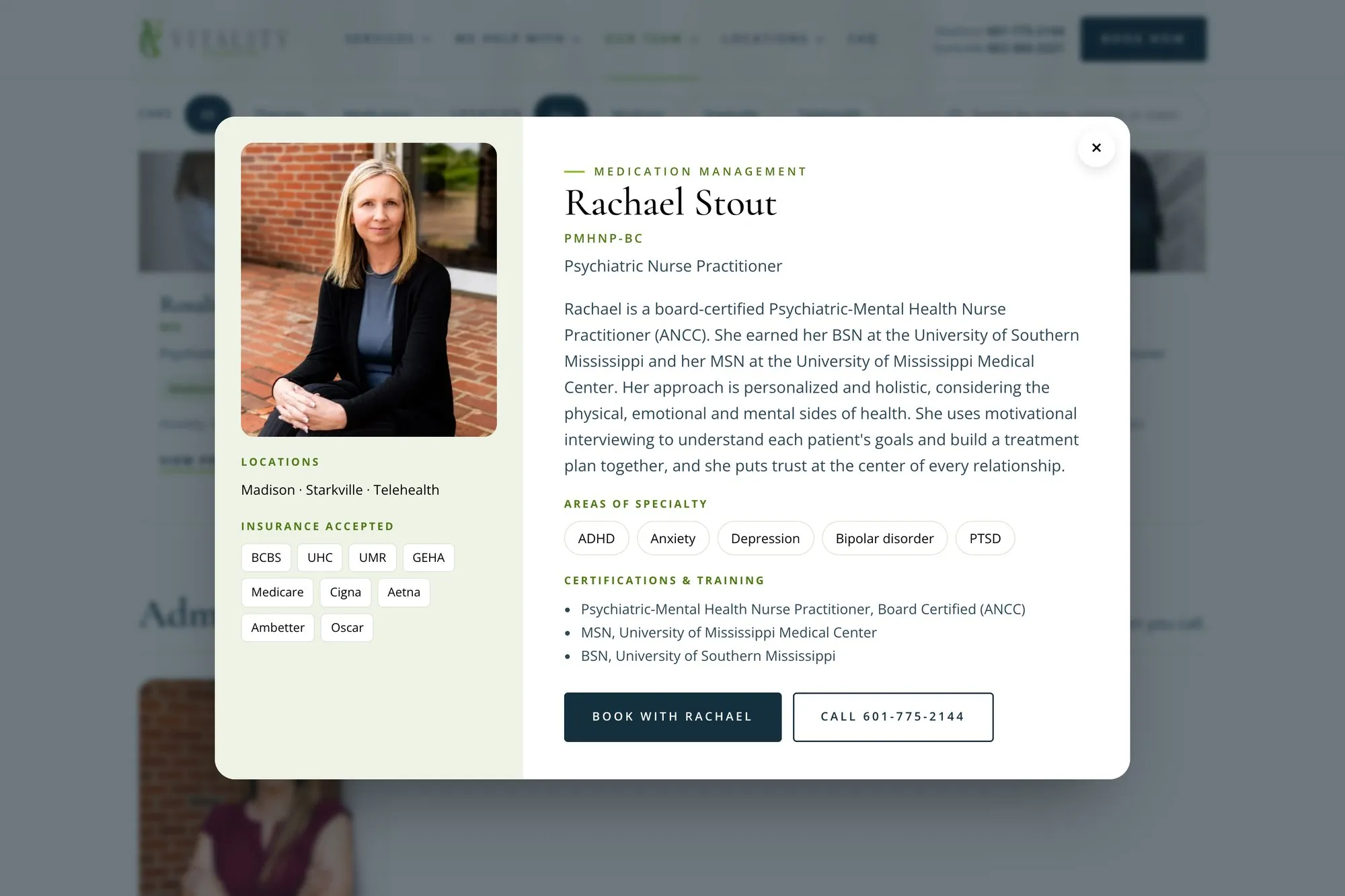
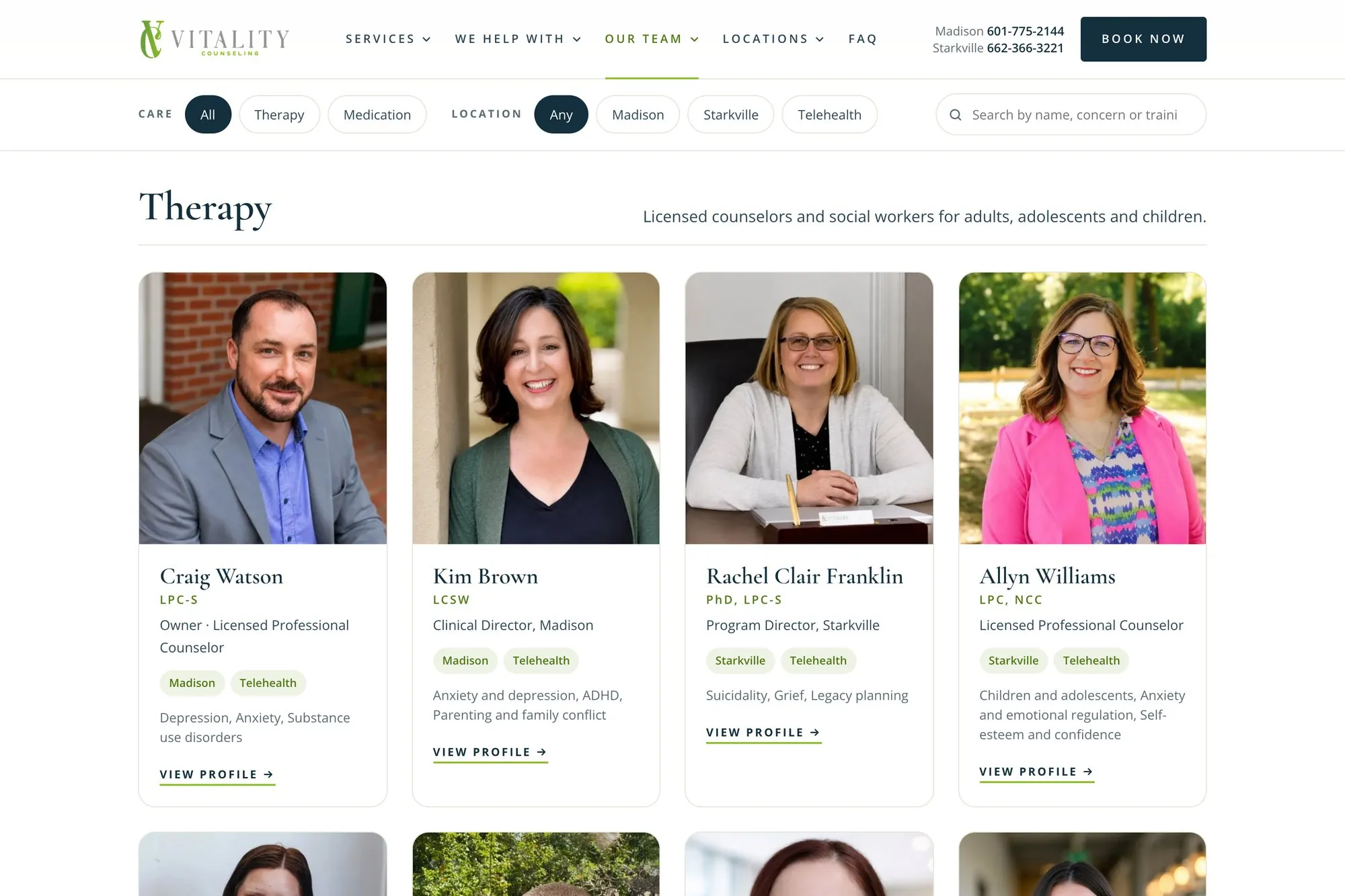
Who to see. The 14 clinician pages became one team directory. Patients can filter by type of care and location, and search by name, concern or training. Each profile opens with a written bio, specialties, training, locations and the insurance that clinician accepts.
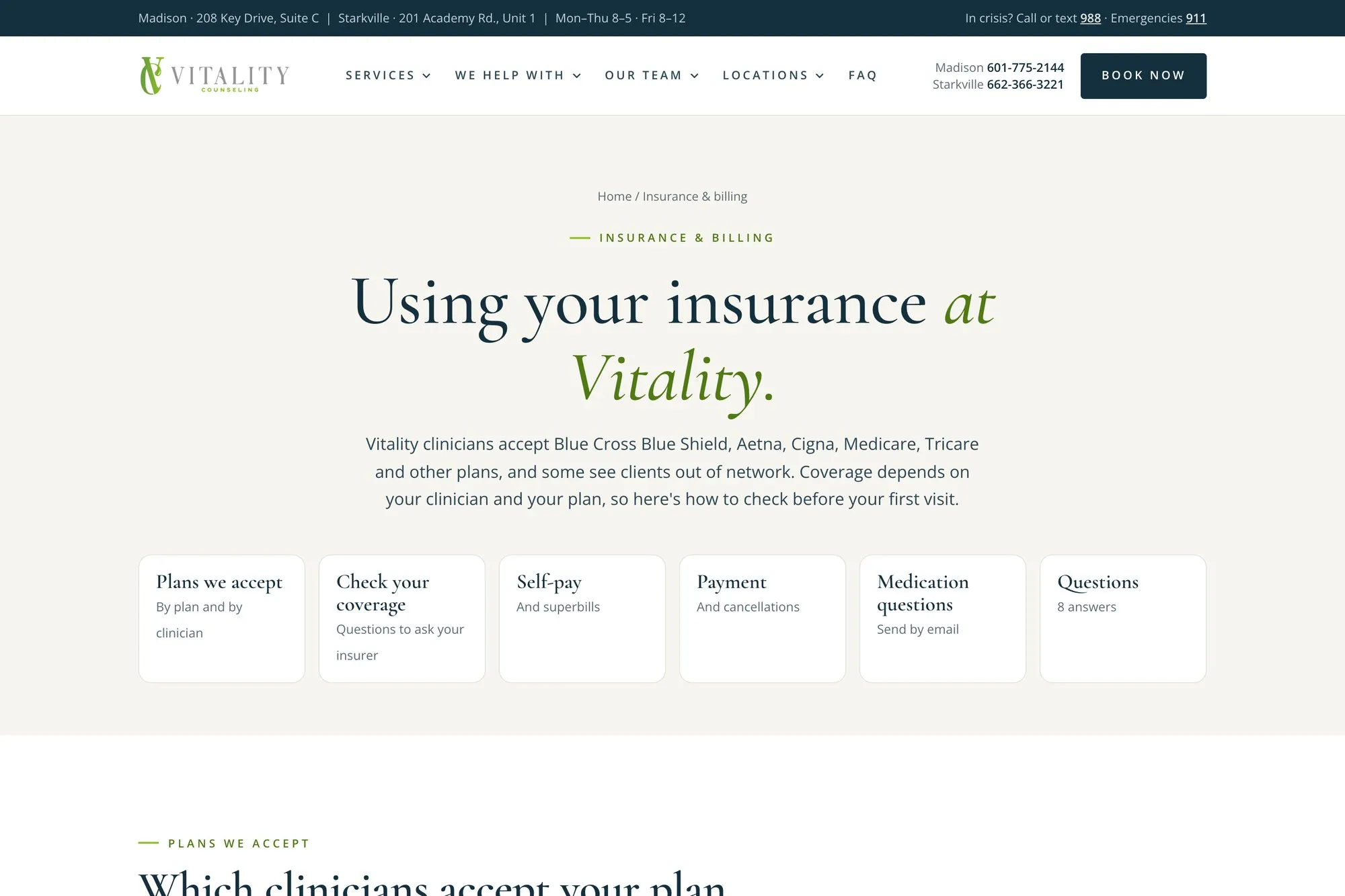
Insurance and booking. A new Insurance & Billing page names the plans Vitality accepts and explains self-pay and payment. Every page opens the same booking form, and each request arrives in the CRM tagged by location.
Compliance. The site now has a privacy policy, terms, a cookie policy, a consent banner, a Notice of Privacy Practices and a data request form. Web chat loads only after a visitor answers the cookie banner.
The Build
Static, Structured and Moved Without Losing a Link
We rebuilt the site as static HTML on Cloudflare. That removed the WordPress theme, the page builder and the plugins, along with the database and admin login that came with them.
Every page carries structured data: the practice, each office with its address, hours and phone, and the clinicians. Condition pages also describe the condition and its symptoms, and 22 pages carry FAQ markup. An llms.txt file gives AI assistants a plain-language summary of the practice.
Every old URL redirects to its new home, including each former clinician page, which now opens that clinician’s profile on the team page. The site went from first concept on 10/20/2026 to launch on 10/26/2026, with Craig’s review in between.
The Results
Measured the Day After Launch
These are the site results, measured on the live domain on 10/27/2026 with the same crawl and Lighthouse tests we ran on the old site:
- 17 pages where there were none. Thirteen condition pages and four service pages now cover what patients search for. The median page went from 60 words of real content to 583, and the site from about 6,100 words to 17,400.
- 27 of 27 pages structurally clean. Each has one H1, a unique title and description, and a correct canonical, compared with 16 of 29 before. No content image is missing alt text.
- Structured data on every page. The practice, both offices and the clinicians are described on all 27 pages, and 22 carry FAQ markup. Before, office markup was on two pages and FAQ markup on one.
- The team page dropped from 10.4 MB to 0.9 MB. On mobile it went from 3.9 MB to 0.7 MB. On a phone, its main content now loads in 2.2 seconds, down from 12.3.
- Faster on phones. The home, Services, Team and Madison pages now score 94 to 99 for mobile performance in Lighthouse, where the old site scored 74 to 97.
- Lighthouse SEO and Best Practices score 100 on all six pages tested. Accessibility rose from 91–93 to 95–99.
- One way to book. One booking form on every page replaced four overlapping booking pages. Each request is tagged by office.
- A complete privacy framework, up from none. The site has a privacy policy, terms, a cookie policy, a consent banner, a Notice of Privacy Practices and a data request form.
The Honest Picture
What the Numbers Can’t Show Yet
The site is one day old. Google is still indexing it, so there is no ranking, traffic or lead data to report. We will run the same search, map and AI answer tests 4–8 weeks after launch and compare them with the baseline above.
Mobile speed took a second pass. At launch, the cookie consent banner’s script held every page back, and the home page loaded about 25 images at once, so several pages showed their main content more slowly than the old site. The day after launch, we stopped the banner from blocking the page, made it a small corner notice, and had the home page load its first photo before anything else. On a simulated slow phone, four of the six pages we test now load their main content in 2.5 seconds or less, and the home page in 3.1 seconds, compared with 3.8 on the old site.
The FAQ page is the exception. It scores 85 on mobile, where the old page scored 89, because for first-time visitors the cookie notice is the largest thing on its opening screen.
There is also no traffic baseline to compare against. The old site’s analytics plugin was installed but never connected, so it recorded nothing. Google Analytics now runs on the new site for visitors who accept analytics cookies, so the next report will start from real data.
Some of the remaining work isn’t on the website at all. Vitality’s map rankings depend more on its Google Business Profiles than on its site, and the Starkville profile is new, with two reviews. A better website gives that office a strong page to send people to. Reviews and local listings are what will move it up the map results.