

Experience design is the discipline of shaping every point where a customer meets your business (your website, landing pages, emails, proposals, and platforms) so that understanding turns into action. It is not decoration. In growth-stage companies, experience design determines whether clarity turns into conversion or friction stalls momentum.
As organizations scale, touchpoints multiply. Each new campaign, page, tool, and team adds another moment where a buyer can get confused, lose trust, or simply leave. When those experiences are unintentional, growth leaks, and it leaks quietly, because nobody owns the space between the touchpoints.
What Is Experience Design, and How Is It Different From Web Design?
Web design is one part of experience design. Web design asks how a site should look and be organized. Experience design asks a bigger question: what does a customer need to understand, feel, and do at every step, and does each touchpoint help them do it?
That includes the ad that sent someone to your site, the form they fill out, the email that follows, the proposal they review, and their onboarding. A beautiful website that hands leads to a slow, generic follow-up is a good homepage attached to a broken journey.
Experience design connects three things:
- User experience (UX): how the experience works, including the paths people take, how easily they find what they need, and where they get stuck.
- Visual and interface design (UI): how it looks and reads, including hierarchy, typography, color, and consistency with the brand.
- Customer journey: the full sequence of touchpoints from first impression to repeat customer, and what each one is responsible for.
Design Is Execution, Not Decoration
Effective experience design removes friction. It guides decisions. It supports conversion. When experiences are built intentionally, users don’t notice the design; they feel clarity and ease.
Design that prioritizes hierarchy, usability, and intent performs better than design focused solely on visual novelty. It respects attention. It accelerates decisions.
Decoration asks, “Does this look impressive?” Execution asks, “Does this help the right person take the next step?” Only the second moves revenue.
What Makes a Website Design Convert?
A website that converts does three jobs in order: it answers the visitor’s question, it proves you can solve their problem, and it makes the next step obvious. Most underperforming sites fail at one of the three, not all of them.
1. It answers the question the visitor arrived with. People land on a page with a specific need: Do you do this? Do you do it for businesses like mine? Where are you? The headline and first screen should answer that in plain language. Clever taglines that require interpretation cost attention you may not get back.
2. It earns trust quickly. Real client names, real results, recognizable logos, reviews, and named people with faces all reduce the perceived risk of reaching out. Proof works best next to the claim it supports, not collected on a testimonials page few visitors read.
3. It makes action simple. One primary call to action per page, repeated where it makes sense. Short forms that ask only for what you need to follow up. A booking option for buyers who are ready now, and a lower-commitment option, such as an audit or a guide, for buyers who are not.
Underneath those jobs are the fundamentals: pages that load fast on a phone, readable text, navigation in your customers’ words, and forms that work on every device.
UX Determines Whether Strategy Works in Practice
User experience is where strategy meets reality. Even the strongest positioning fails if users can’t navigate, understand, or act with confidence.
Thoughtful UX reduces cognitive load, shortens paths to action, and builds trust through consistency. It allows performance marketing, content, and automation to work harder with less resistance.
Consider a company that drives qualified paid-search traffic to its site. The ad promises a specific service, but the click lands on a general homepage. The visitor hunts for the relevant page, meets a long form with no word on what happens next, and leaves. The ad didn’t fail; the experience behind it did. A landing page that matches the ad’s promise, shows relevant proof, and offers a clear next step often does more for cost per lead than any change to the ads.
Warning Signs Your Experience Design Is Costing You Growth
These patterns show up again and again in growth-stage companies:
- Traffic grows but inquiries don’t. Visitors are arriving and not finding a reason or a way to act.
- Sales hears the same basic questions on every call. The website and materials aren’t answering what buyers need to know before they talk to you.
- Leads go cold between the form and the first conversation. The handoff from website to follow-up is slow, manual, or generic.
- Every channel looks a little different. The website, social, email, and sales decks were built at different times by different people, and the brand feels inconsistent.
- The site has been redesigned more than once without changing results. Each redesign changed the look but not the structure, the message, or the path to action.
- Nobody can say which pages produce leads. Without tracking, design decisions are opinions.
If several of these sound familiar, the problem is rarely a single page. It is the system those pages sit in.
Scalable Design Systems Outperform Constant Redesign
Growth breaks when design is rebuilt repeatedly instead of systemized. Scalable design systems allow teams to move faster without sacrificing consistency or quality.
A design system is a shared set of components and rules (page templates, buttons, forms, typography, color, and tone) that every new page, email, and campaign is built from. New landing pages come together quickly and look and behave like the rest of the brand without a review cycle to enforce it.
When experience design is treated as a system, not a series of projects, growth becomes easier to sustain. Improvements compound: a better form pattern or a clearer proof section improves every page that uses it.
How to Improve Your Website’s Conversion Experience: A Practical Checklist
Start with the pages that already get traffic.
- Define one goal per page. Decide the single action each key page should produce: book a call, request an audit, start a quote. Remove or demote anything that competes with it.
- Rewrite the first screen. State who you help, what you do, and the outcome they can expect, in words a customer would use.
- Match pages to the traffic sources. Ads, emails, and social posts should land on pages that continue the same message, not on a general homepage.
- Move proof next to claims. Put a relevant result, testimonial, or client name beside each major promise.
- Shorten the forms. Ask for what you need to follow up well, and say what happens after someone submits.
- Connect the follow-up. Make sure every inquiry reaches your CRM and triggers an immediate, personal-feeling response.
- Fix speed and mobile first. Test key pages on a phone over a cellular connection. If they are slow or awkward there, start there.
- Measure, then iterate. Track form submissions and booked calls by page and by source, and change one thing at a time so you can see what worked.
How Gridwell Approaches Experience Design
At Gridwell, experience design sits inside our Creative & Experience Design service, and it starts with strategy rather than screens. We map the customer journey first, identify where buyers hesitate or drop off, and then design the website, landing pages, email and SMS templates, and sales materials as one connected system. Every site we build connects to the CRM, so an inquiry is captured, routed, and answered instead of sitting in an inbox.
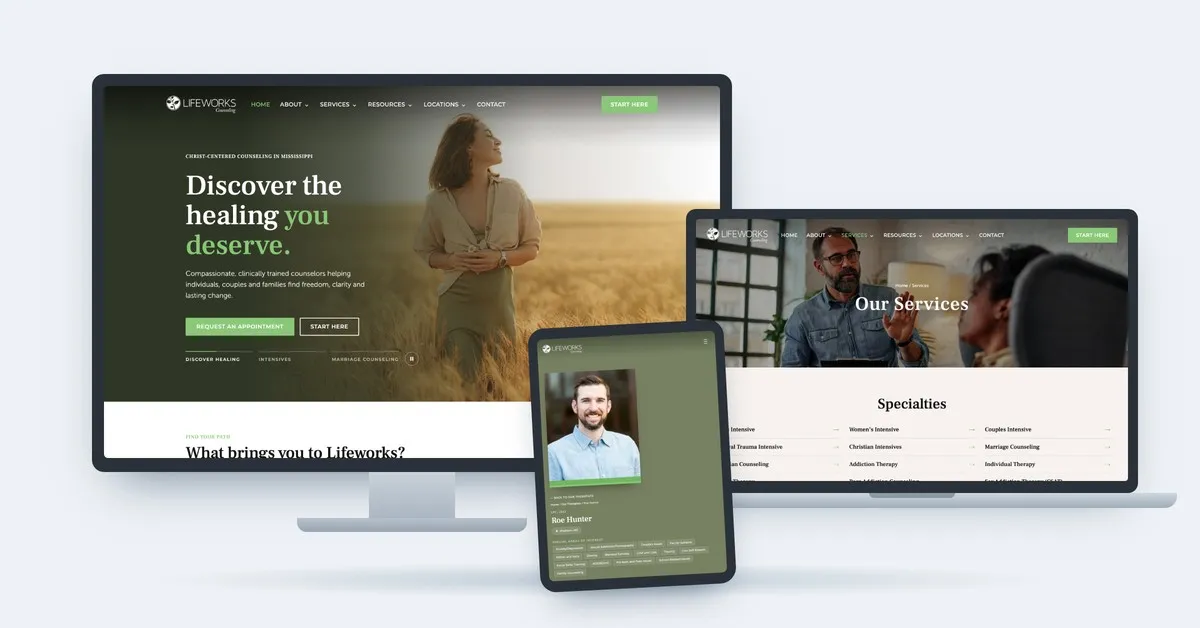
For The Gleaners and Castille Academy, the brand identity and the website were designed together, so the site expresses the brand and moves visitors to act.
If you aren’t sure where your own site is losing people, our free website audit is a practical first step. It looks at performance, search fundamentals, listings, and reputation so you can see what is holding the experience back.
Good design impresses. Great experience design performs.
Frequently Asked Questions
What is the difference between UX design and experience design?
UX design focuses on how a specific product, app, or website works for the person using it: navigation, layout, and ease of completing tasks. Experience design is broader. It covers every touchpoint a customer has with the business, from ads and websites to emails, proposals, and onboarding, and makes sure they work together as one journey.
How do I know if my website design is hurting conversions?
Look for a gap between traffic and inquiries, sales calls that repeat the same basic questions, and leads that go cold after the first form. Then check the fundamentals: page speed on a phone, a clear headline that says who you help, one obvious next step, and tracking that shows which pages actually produce leads.
Should I redesign my website or improve the one I have?
Improve first when the platform is sound and the problems are message, structure, or follow-up; targeted changes to high-traffic pages often deliver the fastest gains. Rebuild when the platform is slow, hard to update, or can’t connect to your CRM and tracking, because every improvement on a weak foundation costs more than it should.
What is a design system, and does a smaller company need one?
A design system is a shared library of page templates, components, and rules for type, color, and tone that every new page and campaign is built from. Smaller companies benefit too: it keeps the brand consistent as more people create materials, and it makes new landing pages faster to launch without starting from scratch each time.
How does experience design support marketing and sales?
Marketing brings people to the door, and experience design determines whether they walk through it. Clear pages make ad spend more efficient, consistent touchpoints build trust across channels, and a connected handoff to the CRM ensures sales receives leads quickly with context, so effort spent attracting buyers isn’t lost at the moment they’re ready to act.