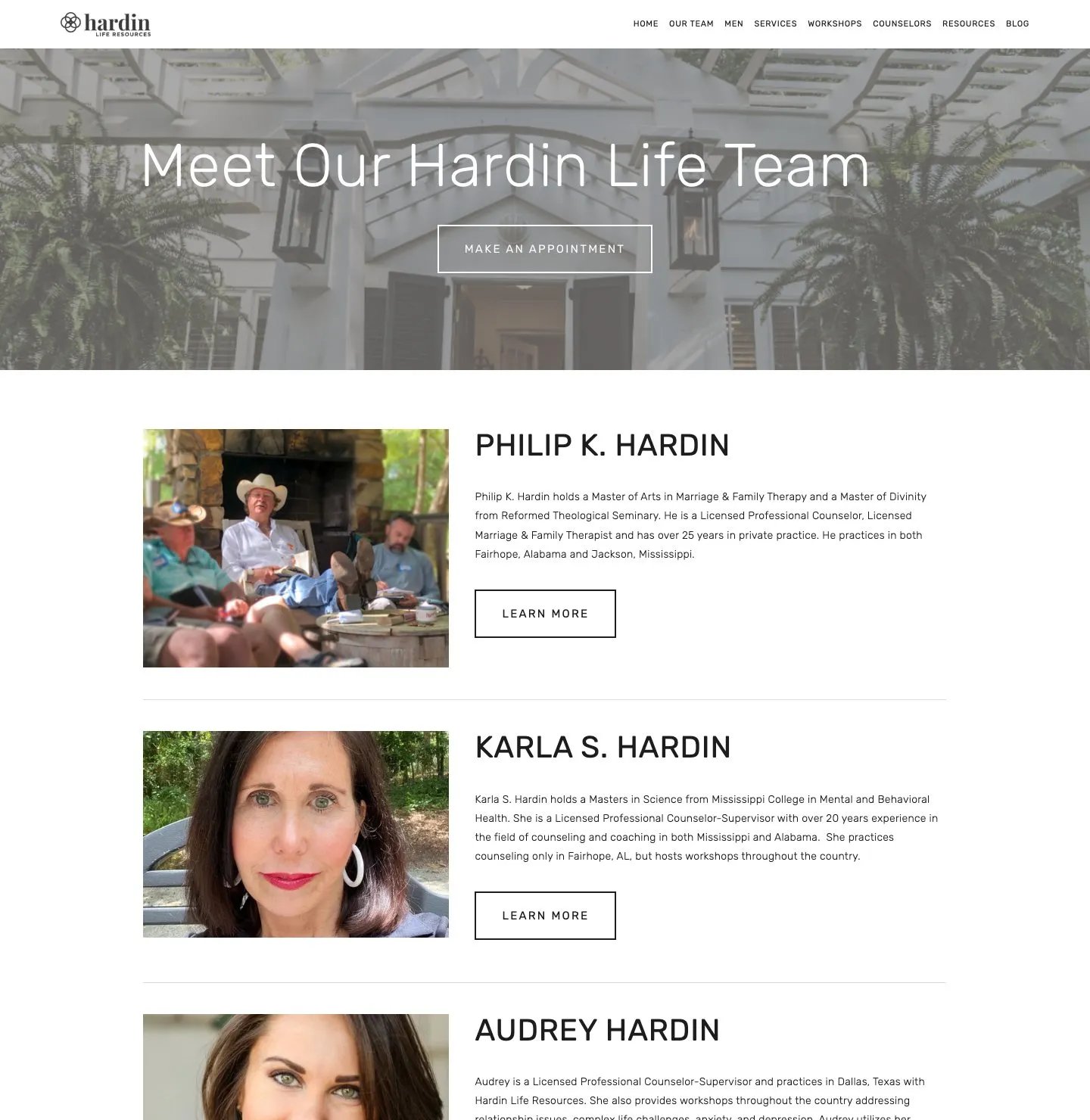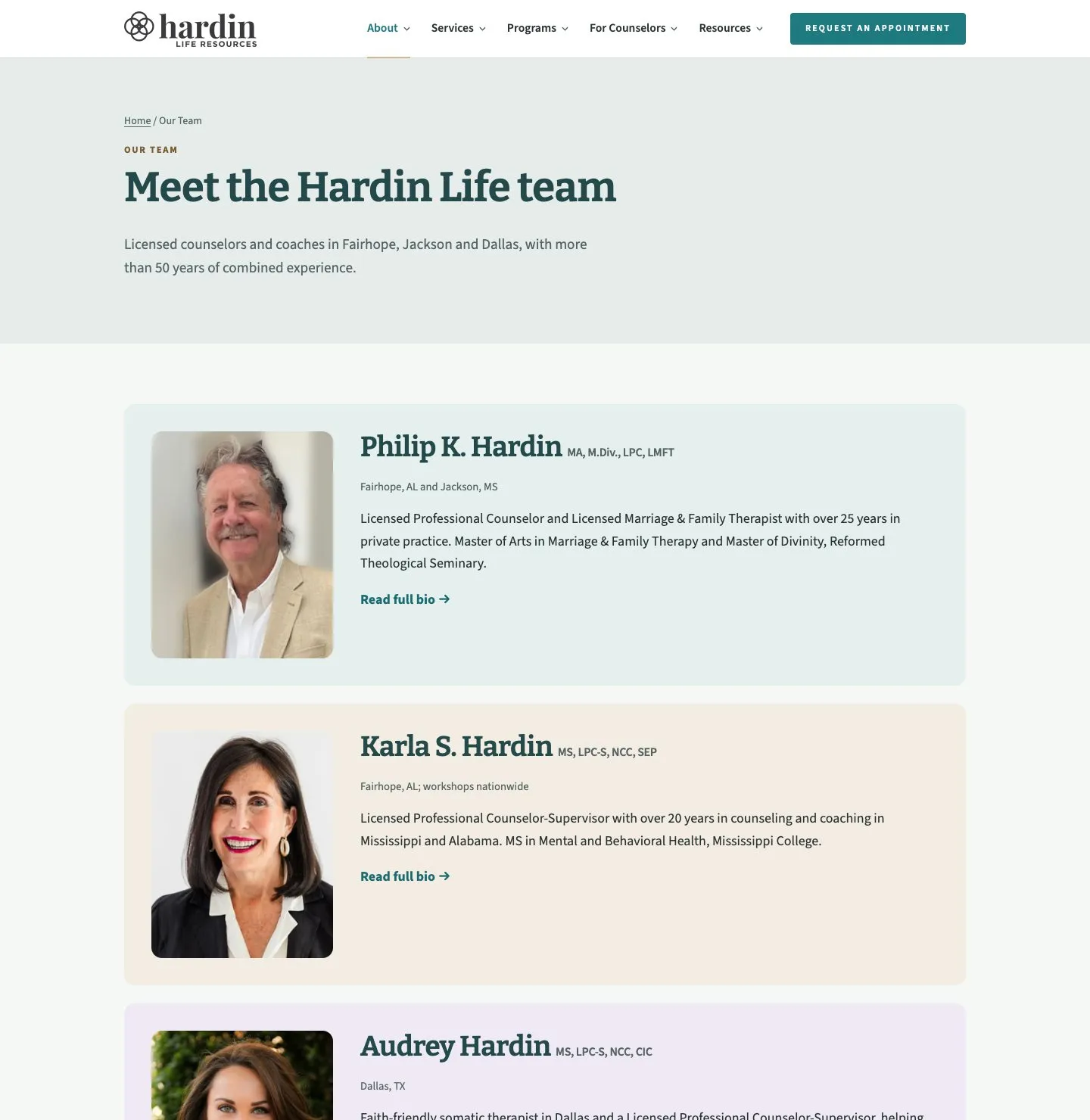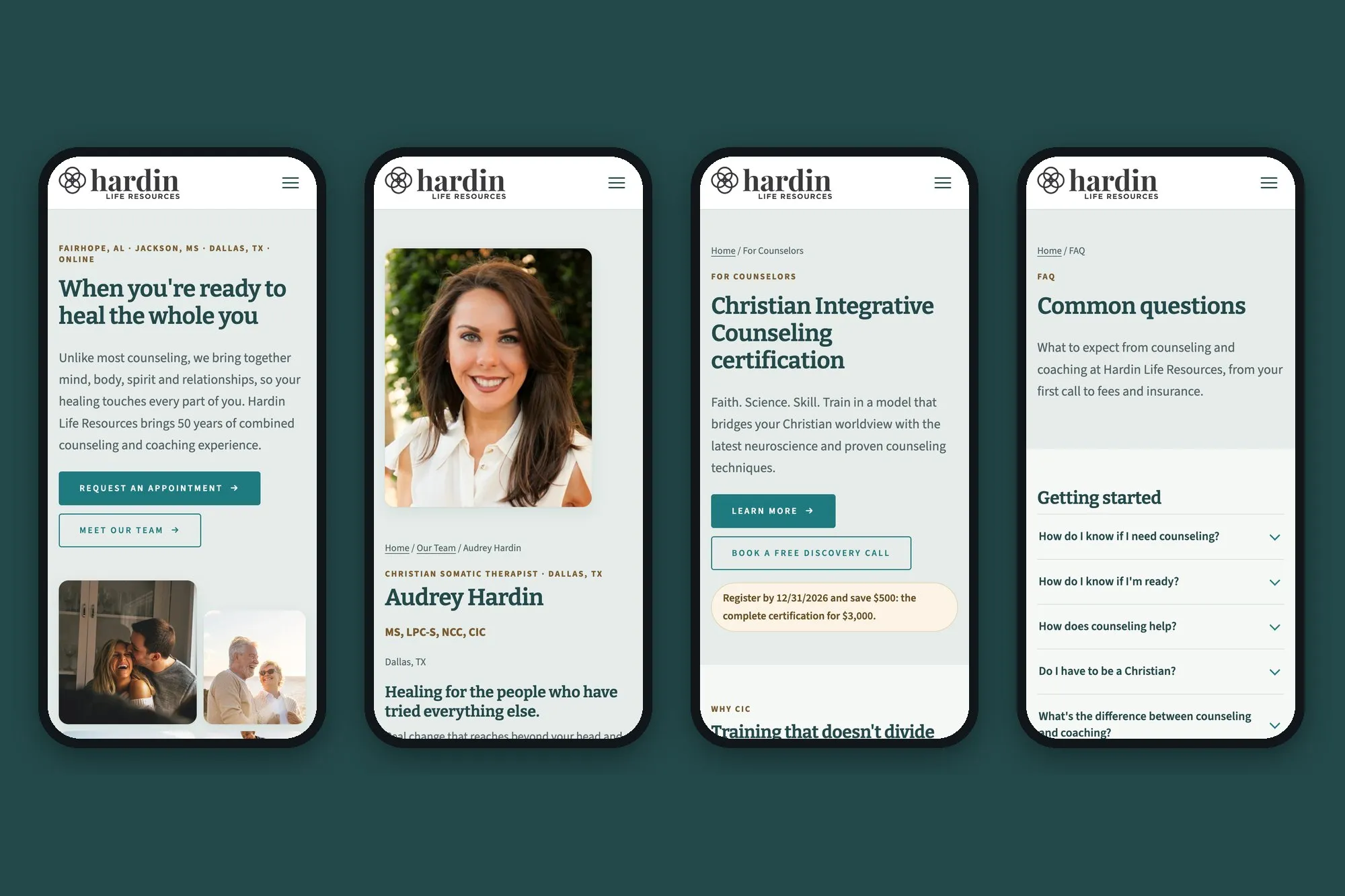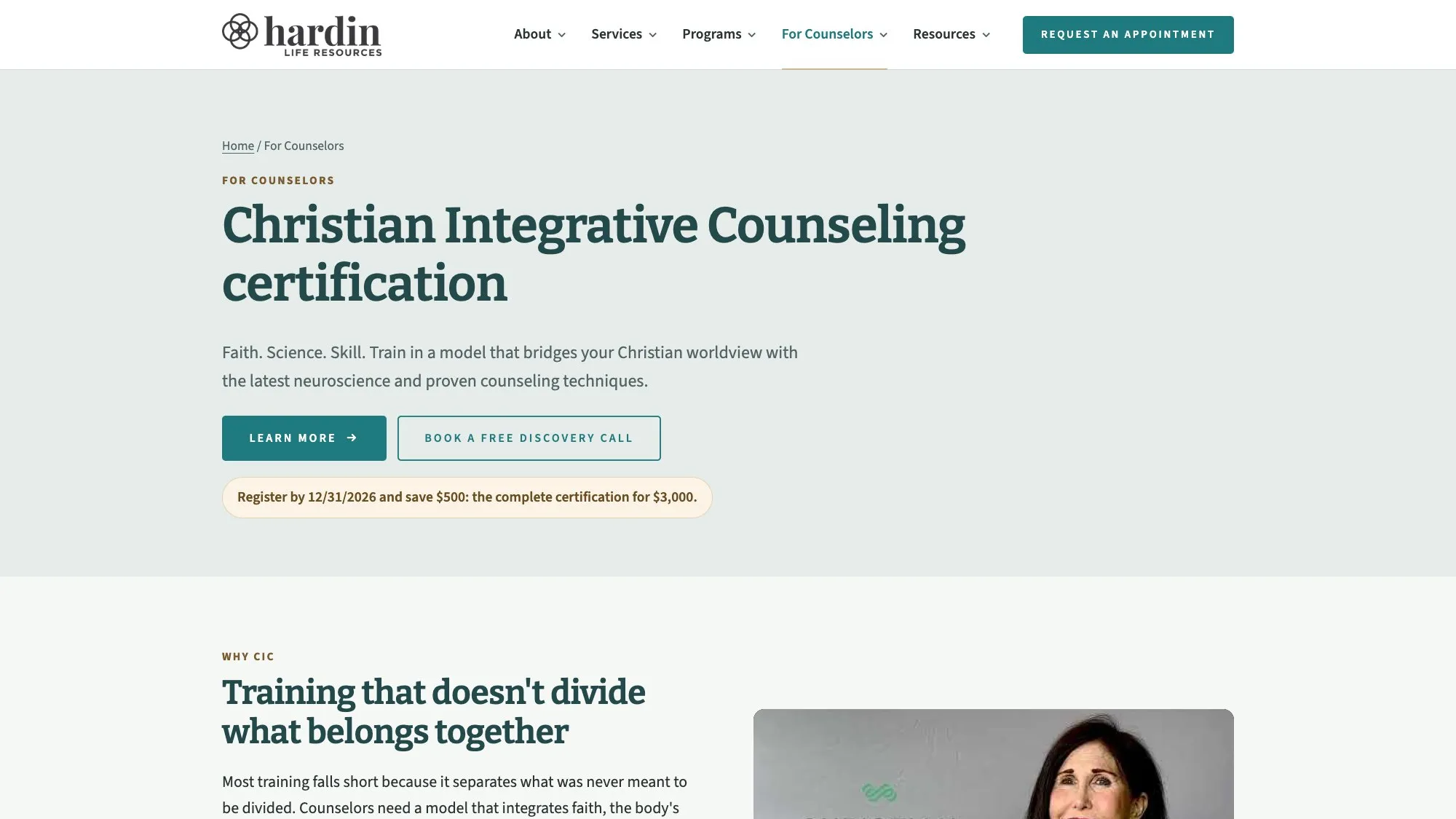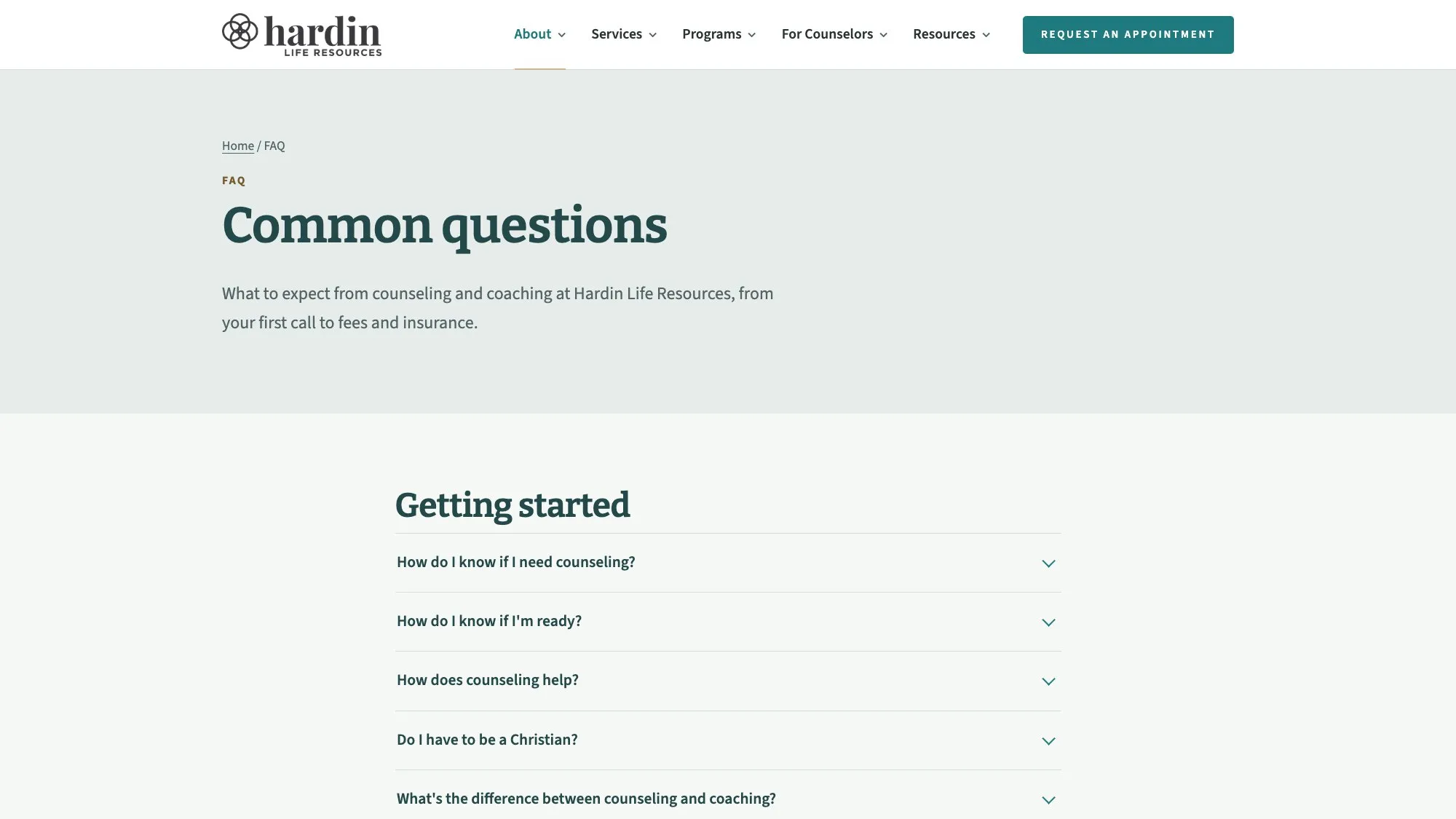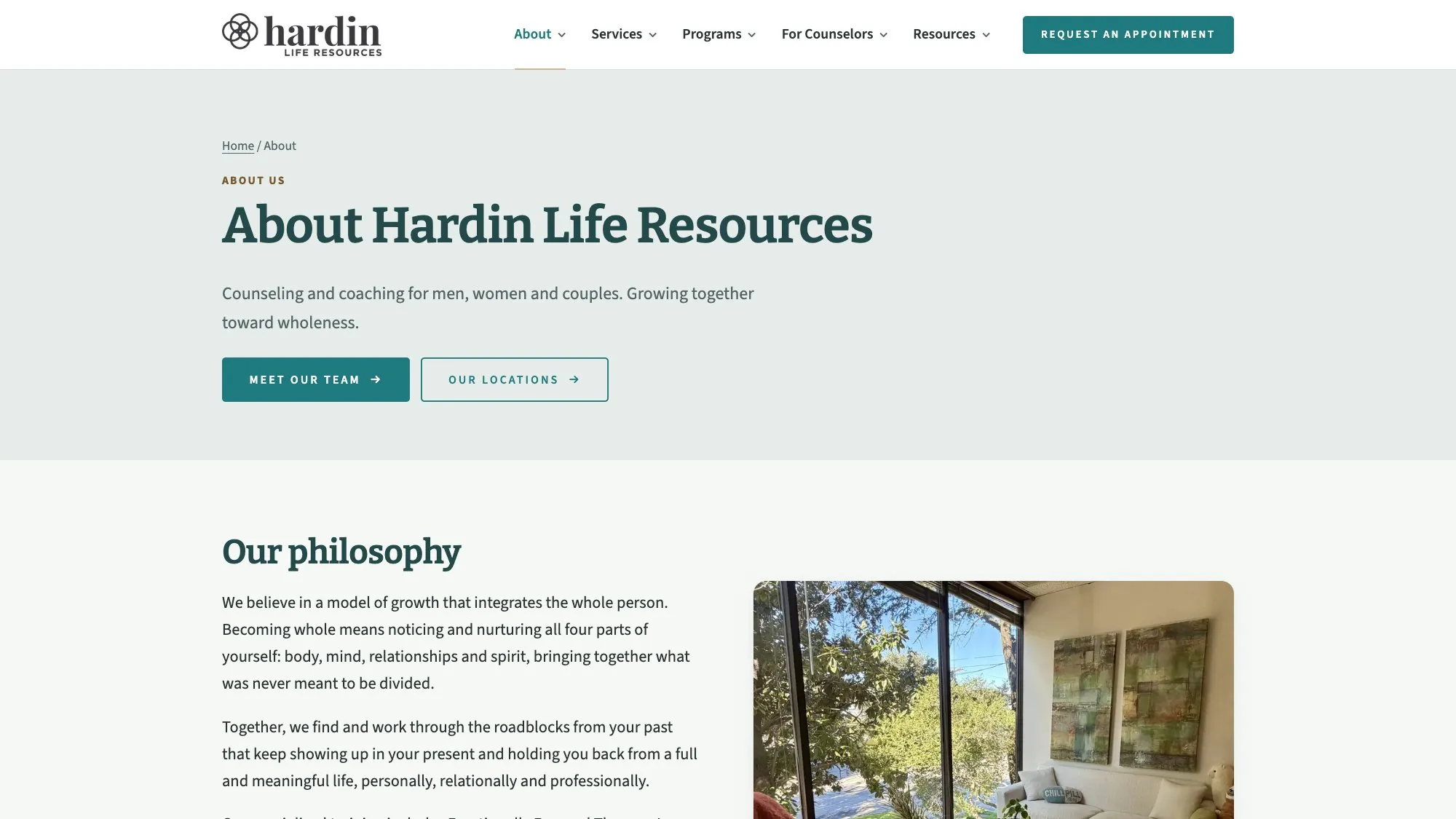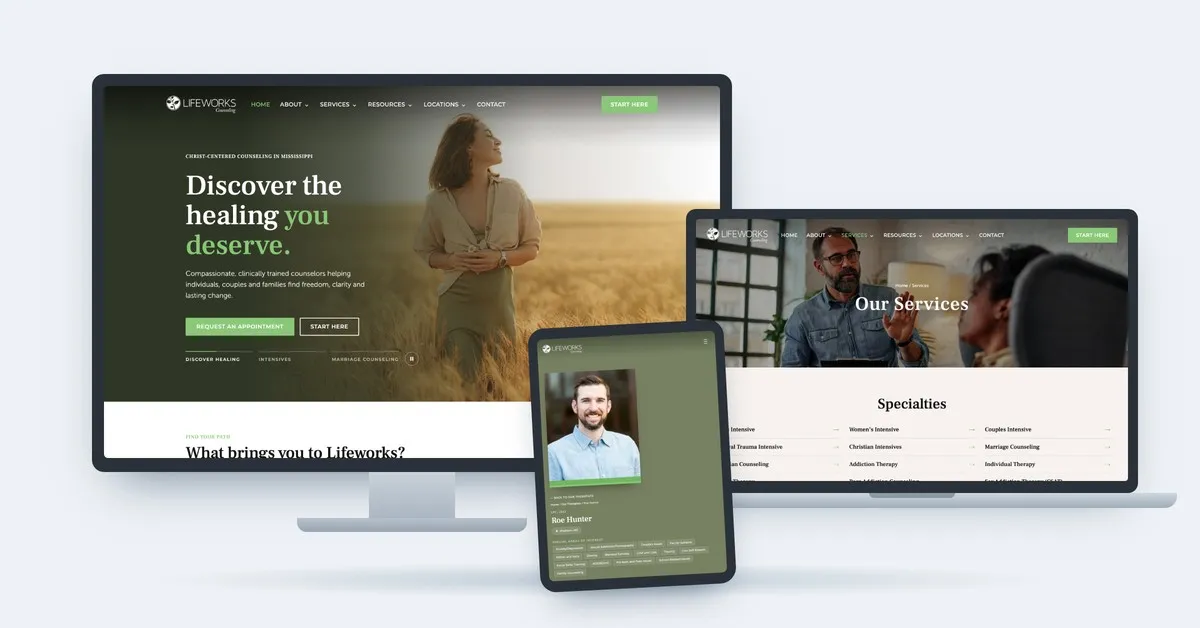

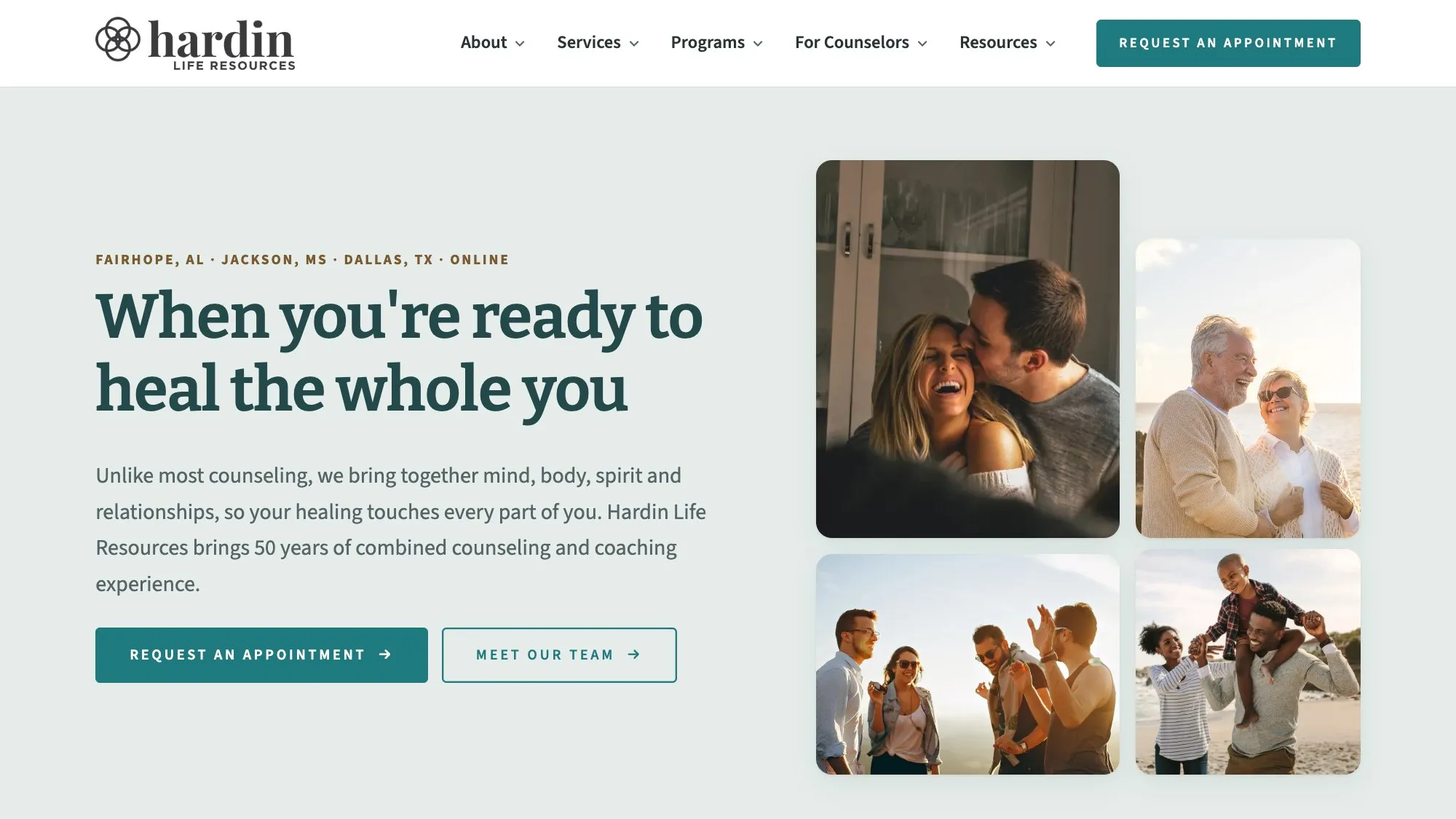
Gridwell moved a Christian counseling practice with offices in three states off Squarespace and onto a hand-built site. Pages that took 6 to 23 seconds to show their main content on a phone now do it in about two, and every page now tells Google and AI assistants clearly who the practice is, who its counselors are and where they work.
The Client
Three Offices, One Whole-Person Model
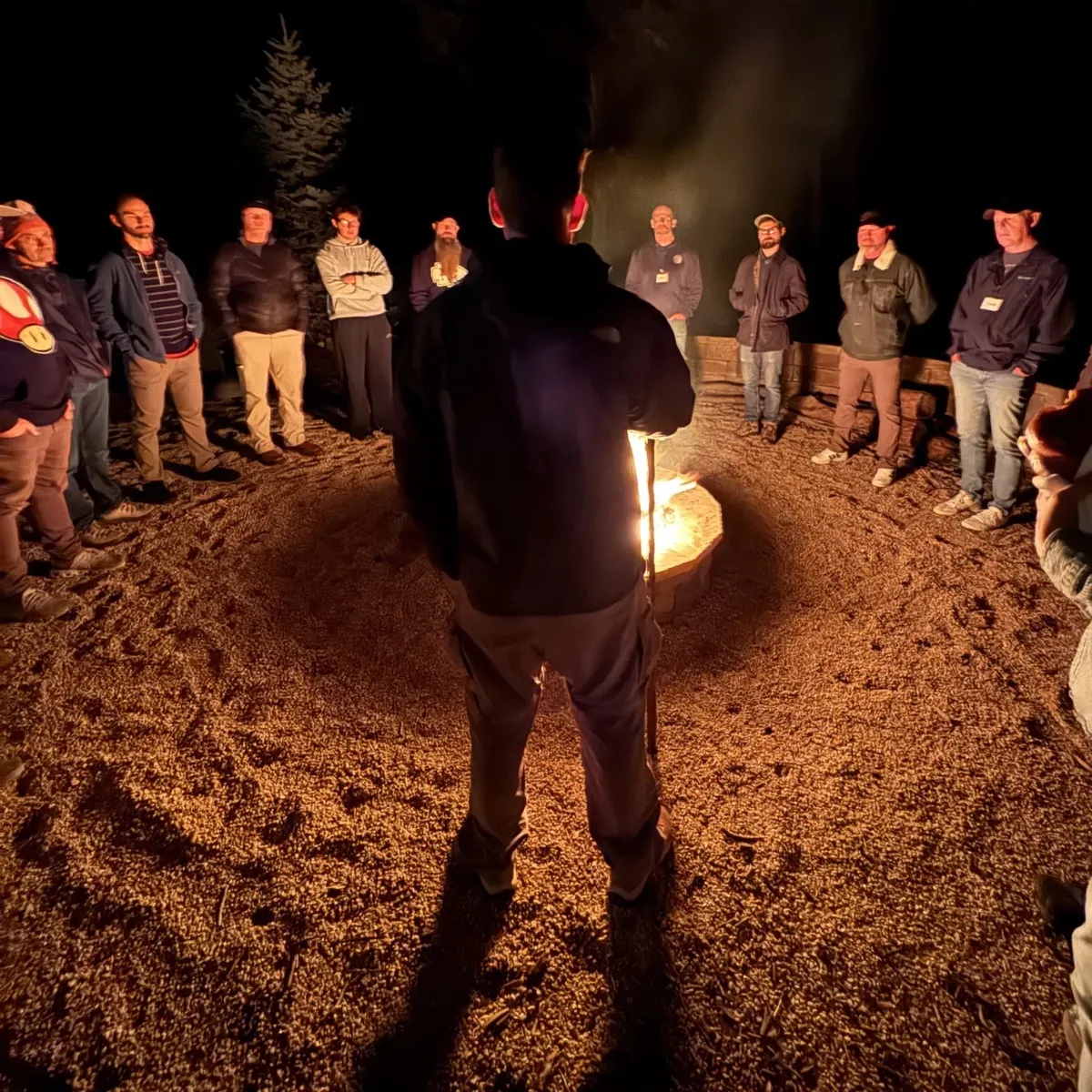
Hardin Life Resources is a Christian counseling and coaching practice with offices in Fairhope, Alabama; Jackson, Mississippi; and Dallas, Texas, plus online sessions. Its licensed counselors work with individuals, couples, teens and families, drawing on attachment theory, trauma-informed care and body-based approaches such as Somatic Experiencing. The practice frames all of it around four parts of a person: mind, body, spirit and relationships.
The practice also trains other clinicians. Founder Karla Hardin created the Christian Integrative Counseling (CIC) certification for licensed counselors and social workers, and the team has published more than 250 articles over the years.
The Challenge
A Site That Stalled on Phones and Said Little to Search Engines
The Squarespace site had served the practice for years. By 2026 it had fallen behind in the two places people now look for a counselor: Google and AI assistants.
Slow on phones. The home page took 6.6 seconds to show its main content on a throttled mobile connection, and inner pages took 10 to 23 seconds. Google’s target is 2.5. The home page alone loaded 7.4 MB across 66 requests.
Weak search signals. 28 of 37 pages had no meta description. 14 had no main heading, including three counselor bios. 226 images had no alt text, and the home page title was just the practice name.
A bloated index. The sitemap listed 2,680 URLs. 2,379 of them were thin, near-duplicate blog tag pages, alongside old scratch and payment pages.
Nothing for AI to read. The only structured data was a generic website label. Nothing described the practice, its offices or its counselors in a form an AI assistant could use.
That matters more in counseling than in most fields. People look for a counselor privately, usually on a phone, often in a hard moment. A page that stalls loses them. And more of them now ask an AI assistant who to call instead of scrolling through results.
The Strategy
Fast First, Then Clear to Google and AI
Speed. We rebuilt every page as static HTML served from Cloudflare’s network, with no page builder, no database and no third-party scripts in the way of the first view. Every photo is WebP in two sizes, so phones download a phone-sized image. Fonts are hosted on the site, and the whole design runs on one small stylesheet and one small script that loads last.
Keep what the practice had earned. All 254 blog posts kept their exact URLs. 58 redirect rules send retired pages, old registration links and payment pages to the right new page, and the 2,379 tag pages now point to the blog archive.
Clean signals. Every page has a written title and meta description and exactly one main heading. Every image has alt text or is marked decorative, and titles name the service and the cities.
Answer-engine optimization. Structured data on every page describes the practice as a counseling business, with both street addresses, phone, service area and social profiles. Each counselor page names the person, their credentials and the practice they work for. All 254 posts are marked as articles with author and date, and the CIC page is marked as a course. A new FAQ answers 16 common questions in plain question-and-answer form, in the practice’s own words. Counselors’ articles end with an author note linking back to their bio, and the crawlers behind ChatGPT, Claude, Perplexity and Google’s AI features can all reach the site.
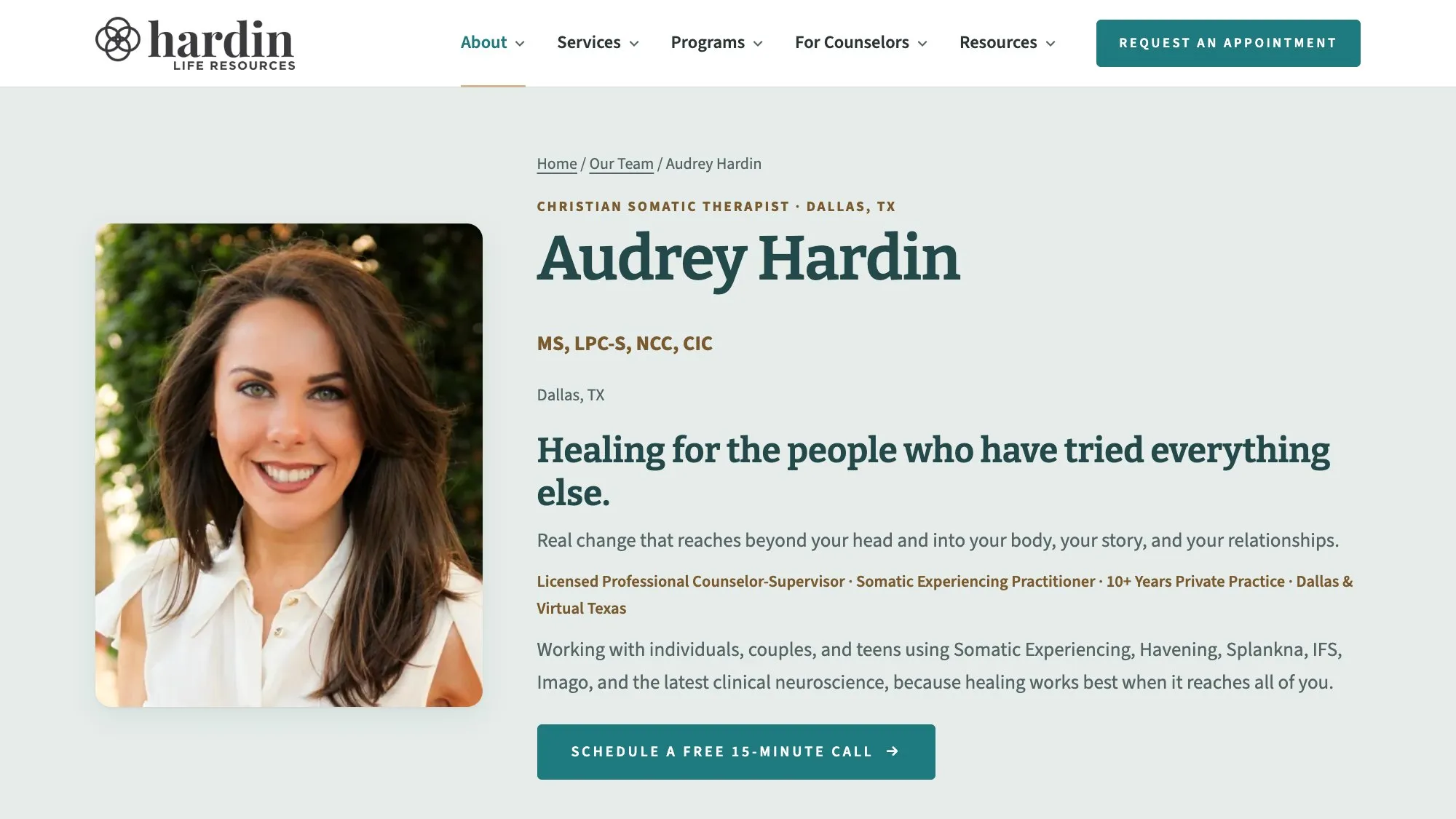
Target phrases. The Dallas counselor gave us the searches she most wants to win, led by “somatic therapist Dallas.” Her page leads with that phrase in its title and description, short labels above her sections carry the rest, and her own copy stays in her words.
The Results
Measured on the Live Site, Launch Day
The site went live on 11/17/2026. Google Lighthouse, simulated mobile, median of three runs, against the same pages on the old site the day before:
- Home: speed score 71 to 98, main content 6.6s to 2.4s, 7.4 MB to 317 KB.
- Counseling: 69 to 99, 11.8s to 2.0s.
- Our Team: 67 to 98, 23.2s to 2.3s, about ten times faster.
- Men’s programs: 69 to 99, 10.1s to 2.0s.
- Blog post: 69 to 96, 10.1s to 2.7s, just over Google’s target.
- SEO and Best Practices: 100 on every page tested. Accessibility is 96 to 100, with zero blocking time and zero layout shift.
- 307 of 307 pages clean. A meta description and one main heading on every page, alt text on every image, and a sitemap of 306 real URLs.
The Honest Picture
Day One Is the Starting Line
This goes up on launch day, so it reports what we can measure now: speed, and how clearly the site describes the practice. Traffic, rankings and appointment requests take weeks to move, and we’ll add them when they do.
A fast site doesn’t create demand on its own. Only the Dallas office has a Google Business Profile, with four reviews; Fairhope and Jackson have none, and no office appeared in the top 20 map results for “Christian counseling” in its city. Those listings and reviews will matter as much as the website. The next phase is measurement and local search: analytics and Search Console on the new site, profiles for the other two offices, and rankings tracked for each counselor’s priority phrases. We captured a full baseline the day before launch, so that work measures against something real.